
Unlike tools, like Hotjar, Matomo and many others, Google Analytics and Ads do not have to be installed with separate scripts. They can load together with a single Google Tag (installation script).
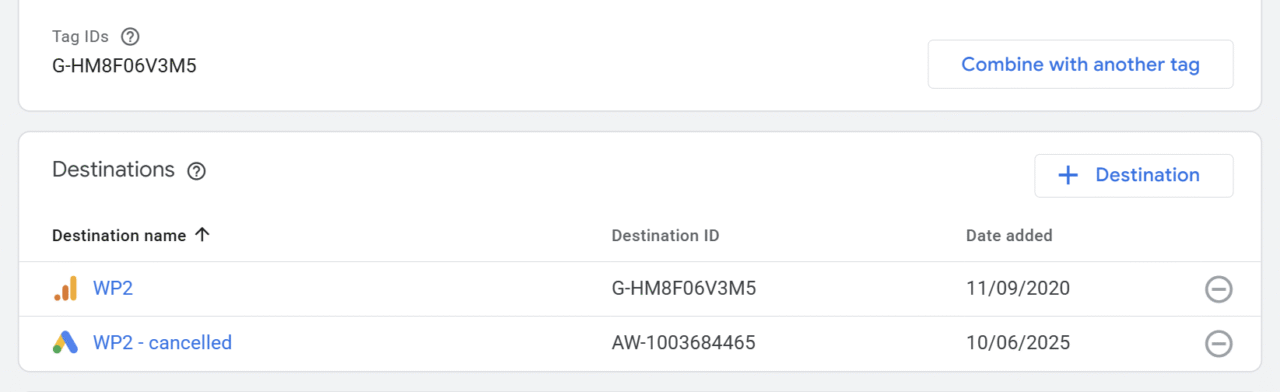
In such cases, sending data to one tracking tool, sends it to many tools, or “destinations” – which can lead to unexpected problems.
Unfortunately, joining these tags is not only encouraged by Google but often is the default option when you install a tracking tool.
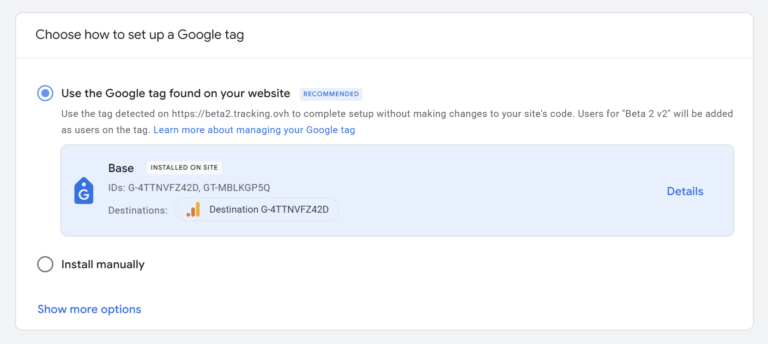
For example, when you install Google Analytics or Ads, they first scan your website for an existing Google tag, to hook into it.
But joining tags is not all bad. There are some good sides of it.
Pros and cons of joined tags
Pros:
- It’s easier to install a tool if you can just side-load it with another one, that’s already installed
- Combined tags can be loaded together via Google Tag Gateway
Cons:
- Combining tags can lead to duplicated event data
- It is difficult to find all the destinations (tracking tools) that are really connected to a tag
- It may sometimes be impossible to remove one destination from a connected tag without sacrificing it
Let me explain…
Problem #1 – double-tracking events
Let’s say we have this situation:
- One website
- Integration with Google Analytics that tracks form submissions
- A separate integration with Google Ads that tracks form submissions
- Your Google Analytics tag sends data to an extra destination – Google Ads
In this situation, your form submission events will be double tracked in both tools.
Why?
Because there are two separate integrations and each of them fires the same gtag() function to track the event.
To prevent duplicating events we would need:
- both tools installed with a single integration,
- the gtag() function fired only once for every event
- or if every event is specifically labelled as “sent to tool X”
In fact WP Full Picture 9.3 and newer use this method to stop Google Analytics and Ads from double tracking the same events.
Problem #2- hidden branches
Google Analytics ands Ads let you view what tools are connected to a single tag

Unfortunately, this only shows the data one level deep, e.g. Tag A sends data to tool A and tool B.
If one of your combined Google tools, has already been combined with a different tool, then you may find yourself with this situation: Tag A sends data to tool A and tool B, which also sends data to tool C.
The only way to find all the branch levels is to go through all the tag IDs in Google Tag Manager.
Problem #3 – Sometimes removing a destination breaks it
This happened to me several times (once during tests and taking screenshots for this article) and so far I have not found a way to avoid it. That is why, it is crucial to only remove destination, that you no longer need.
How to remove extra destinations from a combined Google Tag
Attention. You should only disconnect destinations (tools) you no longer use, e.g. extra Google Analytics or Ads properties. Disconnected tools may stop processing data (e.g. if you keep using them on different sites).
Follow these steps to remove destinations from a Google Tag:
- Go to the screen showing your connected tags (see instructions in the previous section)
- Click anywhere on the graphics showing the tags
- Click the “minus” icon next to the tool you want to disconnect
- Click “create a new tag” in the next step
- Choose “use default configuration” and “copy users”
- Save changes